Blame insomnia. Or, perhaps it's the combination high-temperatures and humidity. I'm cranky. For my self-imposed Japanese lessons, my attempt to keep up with current events while adding to my vocabulary, I turn to my "trusted" news source: TV. The coverage of the news over the past several days is anything but happy. Grim, stupid, and disappointing, I struggle to keep from turning it off.
Pick a channel, any channel, the news being reported focuses on the death of Ms. Mika Yamashita, by all accounts an incredible, brave, and well respected journalist who was shot to death in Syria. Those around her are adamant in saying she was in Syria to cover the plight of women and children. I keep seeing myself in her. Not the whole "incredible, brave, well respected" part. I'm not that arrogant. That there are other women out there who do things few understand, following a drum beat perhaps only they can hear, that she will no longer do this, that some asshole took her life, I really can't describe the sadness and rage I feel. What a waste. What an incredibly stupid, stupid act of violence.
Then there are the politicians and those who feel entitlement in commenting on the acts (or lack thereof) of said politicians--here I'd like to make a suggestion.
The gist is, foreign policy in Japan is in shambles. It's in shambles because the prime minister and his cabinet are busy fending off those who want a new group in power (again), and because there have been four foreign ministers in three years. The ever-revolving door of politicians is tiresome. This, too, is stupid. I understand the consequences of what I'm saying. I stand by it. It's not rocket science. With new people at the top every year or so (sixteen prime ministers in 23 years) how can they possibly be effective?
Here's my suggestion. Stick it out, folks. People want your head? Say you won't go. No more "I take responsibility, and I'll resign." No. Show some umph. Show the country and the rest of the world you have the courage to fend off criticism. Fight. I mean it. Fight.
Because, and here's a biggie, mothers are taking their children to protest Japan's nuclear energy policy, standing outside the Prime Minister's residence in the heat. The Japanese are taking to the streets. There are real protests, perhaps unlike anything seen here since students made noise about the Viet Nam War right around the time I was born. These protests are a big deal. I've stayed away from the nuclear issue, especially as it pertains to Fukushima, as it's a highly emotional topic for both sides, pro-, and anti.
But, I will say this. After the Fukushima Plants went down last year everyone in Tokyo was bombarded with daily reminders to conserve energy. (Tokyo got its energy from these Fukushima Plants.) Trains cut their air conditioning, turned off lights, and used fans to circulate air. Not well, mind you. Department stores used giant fans. All we could get was sort of cool, very stale air. I can't think of anywhere I could go last summer to experience real air conditioning.
Not so this year. Some buildings are almost cold. Trains and subways are back blowing cold air, most welcome. Air conditioning is back. Which begs the question. Where is Tokyo getting its energy? Not Fukushima, of course. There's energy left to spare? Since when? Where's it coming from? Japan does or does not have an energy crisis?
Between the senseless murder of an otherwise incredible woman half way around the world, politicians who just don't get it, mothers who are teaching their children to speak up, and confusion over whether we get to or don't use this energy that may or may not exist--you can see why summer in Japan makes me a bit cranky. Let's see if fall changes anything.
Tuesday, August 21, 2012

Sunday, August 19, 2012
Summer Joy
It only makes sense, and this is truer if you can visualize what Tohoku looks like today seventeen months after the tsunami tore it apart. Seasons change. The only constant element is nature. Life, growth, death, and rebirth is all around. In nature, those of us in Tohoku see this daily. While nature destroys, it also recreates. My last trip up north made me realize this all the more.
Outside the apartment where I stay in Ofunato I see this everyday. I only wish they could sing, a chorus of songs only sunflowers could manage to voice. I would gladly wake up to singing sunflowers. I would even wake up without complaint.
 The reminder "life goes on" has never been clearer. We want beauty in our lives. I don't know anyone who doesn't want a bit of color in our daily routine. Bright is good. Cheerful is better. Sunflowers capture summer joy like I've never felt before, and evidently I'm not alone.
Tohoku is awash with sunflowers. The streets are lined with rows of their strong yellowness.
 Someone planted them, and I find this reassuring. They're beautiful. Tall, proud, showing off their colors, they bring joy. Their faces scream, "Look at me! I'm pretty." Summer is about the culmination of growth, what was planted in spring. We harvest, appreciate, and admire what the season has done for us.
 It's impossible not to grin around these flowers that exude happiness. Clearly I am not alone in feeling this way. Wanting to return to a sense of normalcy, that nature can bestow and not just ruin, the choice (deliberate or subconscious?) of many in Tohoku to plant flowers of joy, the epitomy of summer has not gone unnoticed. I see grandmothers stopped on the sidewalk admiring the mustard-yellow petals. They point at the bees on the brown faces of these flowers. I stand back and watch, grinning once more at the fact there is joy once again here in Tohoku.

Outside the apartment where I stay in Ofunato I see this everyday. I only wish they could sing, a chorus of songs only sunflowers could manage to voice. I would gladly wake up to singing sunflowers. I would even wake up without complaint.
 The reminder "life goes on" has never been clearer. We want beauty in our lives. I don't know anyone who doesn't want a bit of color in our daily routine. Bright is good. Cheerful is better. Sunflowers capture summer joy like I've never felt before, and evidently I'm not alone.
Tohoku is awash with sunflowers. The streets are lined with rows of their strong yellowness.


Wednesday, August 15, 2012
Peaches from Fukushima
There's simply no other way to put this. No amount of money spent on
advertising, neither on television nor in print, like these posters
hanging in trains running through the Tokyo underground will ever
convince me.
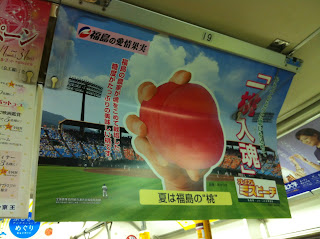 And, I'm sorry about that. But, and really, peaches grown in Fukushima? An advertising campaign is supposed to make me go buy them?
They are grown with care. The farmers in Fukushima "put our hearts and souls" into these peaches. They're juicy and sweet. So the posters tell me. I'm sure they are grown with care. I have no difficulty believing the farmers did everything in their power to pick the best, ripest, pinkest peaches to sell. They might even be extra juicy.
But, and really, but they're grown in Fukushima. People. I can't. I just can't.
Can you really prove to me they're safe? The radiation levels may have been measured and measured again. I'm not actually coming out and saying I don't believe the results. I'm just saying, again mind you, they're grown in Fukushima.
That the farmers in Fukushima need income I get. That the farmers in Fukushima need hope I understand. It's the getting from "wanting to help" part to "buying food raised in potentially radioactive soil" part that I have difficulty with. This is why this ad blitz confuses me. Do they really hope to change our minds? My mind?
Here's the thing. It is peach season. And, white peaches here in Japan are something else. There's no eating them without a towel in hand. Juices drip down my chin. They're practically messy they're so wet and full of pulp. Peach season is summer. Watermelon, barley tea, muggy weather, fireworks, mosquitoes, and peaches--this is summer in Japan. That Fukushima is trying to be a part of traditional Japan, summer food, family fun, I want to help with this. But, sorry. Dear Farmers, I just can't do it. I'll let you know if I change my mind. 'Til then.

They are grown with care. The farmers in Fukushima "put our hearts and souls" into these peaches. They're juicy and sweet. So the posters tell me. I'm sure they are grown with care. I have no difficulty believing the farmers did everything in their power to pick the best, ripest, pinkest peaches to sell. They might even be extra juicy.
But, and really, but they're grown in Fukushima. People. I can't. I just can't.
Can you really prove to me they're safe? The radiation levels may have been measured and measured again. I'm not actually coming out and saying I don't believe the results. I'm just saying, again mind you, they're grown in Fukushima.
That the farmers in Fukushima need income I get. That the farmers in Fukushima need hope I understand. It's the getting from "wanting to help" part to "buying food raised in potentially radioactive soil" part that I have difficulty with. This is why this ad blitz confuses me. Do they really hope to change our minds? My mind?
Here's the thing. It is peach season. And, white peaches here in Japan are something else. There's no eating them without a towel in hand. Juices drip down my chin. They're practically messy they're so wet and full of pulp. Peach season is summer. Watermelon, barley tea, muggy weather, fireworks, mosquitoes, and peaches--this is summer in Japan. That Fukushima is trying to be a part of traditional Japan, summer food, family fun, I want to help with this. But, sorry. Dear Farmers, I just can't do it. I'll let you know if I change my mind. 'Til then.
Tuesday, August 14, 2012
On Not Mincing Words and 100 Yen Shops
Growing up, confrontation, blunt talk, saying what one really means was simply not a part of daily life. Subtlety, implications heavy with nuances, hidden intent not clearly spelled out, all this was normal in Japan. Imagine my shock then, fast-forwarding several decades when it's now okay to say what until now was kept inside. Don't get me wrong. It's not that all polite talk has been replaced with directness. Make no mistake. For the most part, tact still rules. There are, however, exceptions. These are noticeable. These stand out.
There's this, for example.

It reads, "How many times I gotta say it?! If you drink, don't drive."
This is blunt in Japan. It's almost shocking. It's the smack across the head to those stupid enough to break rules.
Then there's this.
"It's not that you can't. It's that you don't." Particularly applicable post-March 11th, for those Japanese (in particular) who are "too busy" and for whom "Tohoku is alright, right?"
 I find this refreshing. There are those here in Japan who will say this kind of frankness is the result of an educational system that promotes self-assertion, a no-no until several decades ago when group-think was the norm. As an American, I know it's not my place to plug any one "norm" where it's not welcome. No one culture is superior to another.
Those subjects alone could turn into several dissertations, so I'll save them for another day. This notepad, the one on the right was bought at one of Japan's many 100 yen stores. My new Mecca, I pretty much decorated my entire apartment with items brought here. Some stores are small "hole-in-the-wall" shops while others take up four floors of a department building. The merchandise sold here is not high-end, and it's most certainly not fashionable. It "passes" which isn't bad for someone on a budget.
After dinner one night, I passed one such store as I made my way back to the bus stop. At first I kept going, but then turned around and made my way down into the basement. I could afford 500 yen on items I didn't otherwise know I needed. It's a short-term shopping fix.
The notepad caught my eye. I don't need it, of course. It begged to be bought. The notebook fairy called out, "Buy me. Buy me." I obliged. If nothing else, a conversation piece it would be. "Who do you think it's referring to?" "It's true, don't you think?" "It's okay to be that blunt if you're telling the truth. Or no?"
I will pull it out of my bag at hopefully just the right moment and see the reactions both it and I receive. Blunt talk and 100 yen shops. An unlikely duo if there ever was one.
There's this, for example.

It reads, "How many times I gotta say it?! If you drink, don't drive."
This is blunt in Japan. It's almost shocking. It's the smack across the head to those stupid enough to break rules.
Then there's this.
"It's not that you can't. It's that you don't." Particularly applicable post-March 11th, for those Japanese (in particular) who are "too busy" and for whom "Tohoku is alright, right?"

Those subjects alone could turn into several dissertations, so I'll save them for another day. This notepad, the one on the right was bought at one of Japan's many 100 yen stores. My new Mecca, I pretty much decorated my entire apartment with items brought here. Some stores are small "hole-in-the-wall" shops while others take up four floors of a department building. The merchandise sold here is not high-end, and it's most certainly not fashionable. It "passes" which isn't bad for someone on a budget.
After dinner one night, I passed one such store as I made my way back to the bus stop. At first I kept going, but then turned around and made my way down into the basement. I could afford 500 yen on items I didn't otherwise know I needed. It's a short-term shopping fix.
The notepad caught my eye. I don't need it, of course. It begged to be bought. The notebook fairy called out, "Buy me. Buy me." I obliged. If nothing else, a conversation piece it would be. "Who do you think it's referring to?" "It's true, don't you think?" "It's okay to be that blunt if you're telling the truth. Or no?"
I will pull it out of my bag at hopefully just the right moment and see the reactions both it and I receive. Blunt talk and 100 yen shops. An unlikely duo if there ever was one.
Friday, August 10, 2012
Conspiracy Theories and the Price of Food
After having spent almost a month up north, I'm back in Tokyo. Holed up in my apartment, air conditioner on high, I'm avoiding people. Anyone I don't absolutely have to see I don't. I need space. I need to think about the benign. I want my weekend to be uninteresting. My sponge, body and mind and soul is full. Watching mindless television, doing nothing productive, I'm slowly wringing out my sponge. Which is why I have the luxury to contemplate the following.
With no need to dress up in Tohoku, I live in cut-off jeans and t-shirts. Make up is reserved for the days I see someone who hasn't seen me without. I walk around town in my sandals. Flip-flops, really. My feet are dirty at the end of each day, but I see this as a mark of where I've been, what I've accomplished, and not anything negative.
Walking on sidewalks, running around pre-school playgrounds with kids in sandals, a natural conclusion might be "your feet must be taking a beating." Not true. The conclusion of wearing flip-flops for a month? No blisters.
Which is why, after day three of being in Tokyo, I marvel in disgust at my feet. They're once again covered in blisters. I'm wearing the same sandals I've worn in Tohoku for the past month. What gives? Why do Tokyo sidewalks give me blisters when Tohoku sidewalks don't?
If this phenomenon were an isolated incident, if somehow I walk funny when I'm in Tokyo I might dismiss this. I am not, however, and I say this with a combination grin-grimace, the only woman in Tokyo who has "foot problems." Indeed, blistering feet is the norm here in Tokyo.
This begs the question...what are Tokyo sidewalks made out of that ruin our feet so? Is this why people in Tokyo walk fast? Is this why people seem to be busier? In a hurry? Do people get more done in Tokyo, walking fast from place to place so we can finish our days sooner, all in avoidance of the blisters we know we'll have when we get home? Is there some secret ingredient in the concrete concoction? I'm only half-kidding. Conspiracy theory anyone?
Freedom to contemplate the absurd doesn't stop here. I continue to be amazed at the price of food in the supermarkets. Do people really pay six dollars for two nectarines? Seven dollars for a mango? Do they taste better? Are they worth the price? The 100 dollar watermelons displayed at high-end shops aside, I've begun to wonder if I'm really that poor or if the average Japanese housewife really has managed to tuck away that much money for fruit.
Then there are the tomatoes. I've read the labels. I've looked at where they're grown. I can't seem to find the "secret" that makes tomatoes in Japan worth paying this much for. Simply put, they're delicious. Juicy, sweet, bright red balls of goodness they are. For these, I'll gladly pay four dollars for six small ones. Why do I not trust the mangoes to be as good? Probably because I can buy five of the same mangoes for five dollars back home. No one mango can be that good, and certainly not worth seven dollars. Tomatoes though, ah. For these, I gladly make an exception.
Evidently there's something to be said for a weekend spent doing nothing. The tomatoes I had for my afternoon snack clearly gave me fuel and inspiration. As did my new blisters.
With no need to dress up in Tohoku, I live in cut-off jeans and t-shirts. Make up is reserved for the days I see someone who hasn't seen me without. I walk around town in my sandals. Flip-flops, really. My feet are dirty at the end of each day, but I see this as a mark of where I've been, what I've accomplished, and not anything negative.
Walking on sidewalks, running around pre-school playgrounds with kids in sandals, a natural conclusion might be "your feet must be taking a beating." Not true. The conclusion of wearing flip-flops for a month? No blisters.
Which is why, after day three of being in Tokyo, I marvel in disgust at my feet. They're once again covered in blisters. I'm wearing the same sandals I've worn in Tohoku for the past month. What gives? Why do Tokyo sidewalks give me blisters when Tohoku sidewalks don't?
If this phenomenon were an isolated incident, if somehow I walk funny when I'm in Tokyo I might dismiss this. I am not, however, and I say this with a combination grin-grimace, the only woman in Tokyo who has "foot problems." Indeed, blistering feet is the norm here in Tokyo.
This begs the question...what are Tokyo sidewalks made out of that ruin our feet so? Is this why people in Tokyo walk fast? Is this why people seem to be busier? In a hurry? Do people get more done in Tokyo, walking fast from place to place so we can finish our days sooner, all in avoidance of the blisters we know we'll have when we get home? Is there some secret ingredient in the concrete concoction? I'm only half-kidding. Conspiracy theory anyone?
Freedom to contemplate the absurd doesn't stop here. I continue to be amazed at the price of food in the supermarkets. Do people really pay six dollars for two nectarines? Seven dollars for a mango? Do they taste better? Are they worth the price? The 100 dollar watermelons displayed at high-end shops aside, I've begun to wonder if I'm really that poor or if the average Japanese housewife really has managed to tuck away that much money for fruit.
Then there are the tomatoes. I've read the labels. I've looked at where they're grown. I can't seem to find the "secret" that makes tomatoes in Japan worth paying this much for. Simply put, they're delicious. Juicy, sweet, bright red balls of goodness they are. For these, I'll gladly pay four dollars for six small ones. Why do I not trust the mangoes to be as good? Probably because I can buy five of the same mangoes for five dollars back home. No one mango can be that good, and certainly not worth seven dollars. Tomatoes though, ah. For these, I gladly make an exception.
Evidently there's something to be said for a weekend spent doing nothing. The tomatoes I had for my afternoon snack clearly gave me fuel and inspiration. As did my new blisters.
Wednesday, July 25, 2012
Life and Death at 17
I've often said here in Tohoku, the difference between who's a "local" and who's from "away" is pretty drastic. Introductions are peppered with "I'm so-and-so's child" and "my dad owns the such-and-such store." This places people. Pecking order, family feuds, whether or not business transactions will take place, if friendships will be established, these are all set by these pronouncements of placement. Exempt from this, I tell people I am from the outer most layer of the onion.
The onion is comprised first of family, then local block, neighborhood, city, locality, prefecture, region, country, and the rest of the world. I'm from the "outer, outer, outer, outer, outer" layer. The number of "outer"s I say out loud isn't the point. It's more about the fact I'm from "way, way, way out there."
I long ago learned how much of an advantage this is. Locals don't complain as it is, much less to their neighbors. "We're all in the same boat," I've been told, over and over. Everyone here is a victim of disaster in one way or another. I'm not. That I represent the furthest place out people can imagine means I'm safe to complain to. That I can't possibly relate makes it easy to identify me as someone who can listen. Most of all, that I'm anything but a "local" means it's okay to say to me what can't be said to family and friends.
There's another sort of "outsider." There are several locals who have been anointed with this sacred bond of trust. The unwritten credo of not complaining to anyone "from here" is broken, and blatantly at that with these few. Takayuki Niinuma is one of the chosen.
His job description on Facebook is "Mayor of the Night in Ofunato." If you knew him you'd see how perfect this was. He drives a flashy car with tinted windows. He swaggers just a bit. He projects "bad." For those who can't see through to his inner core, he's feared. Shunned. He has a past worthy of this reputation. A trouble-maker in town since he was a kid, his language is coarse. He doesn't mince words. People walk the other way when they see him coming. This makes him, for some, the perfect confidant.
Those who are truly at the bottom, who don't know how to keep going, who've lost the will to go on, who have such tragic stories they can't possibly be real--these people find Taka. The stories people tell him are nightmarish. This is one such story.
The sports center in Rikuzentakata with its large gymnasium was a designated evacuation spot. In the case a tsunami hit the city, residents were to come here. Hundreds of people gathered here a year ago on March 11th to wait out the tsunami warning. No one, no one ever expected the wave to be high enough to flood the gym.
"When the tsunami came, it blew in the front door, water poured in from the second story windows, and next thing they knew everyone who wasn't already dead fought their way up to these beams," Taka tells me.
 "This 17-year old girl and her friends, they were all hanging on to these beams on the ceiling. Below them is this whirlpool of water with crap in it. They know if they let go they're dead." I think back to what I saw in the gym when I visited last time, and I start to shake.
"Then the wall blew out." The pressure from the water and the wave continuing to crash in did indeed blow out a wall. "This meant the water that was holding them up, they're hanging onto the beams, right? This water got sucked out through the hole in the wall with real force. People couldn't hang on. Some got swept out along with the pull of the water flowing out, and others clung on for dear life. This girl clung. This girl saw this. She saw all this. There's more. Those who are hanging on just with their hands, they're hanging onto these beams by their hands, right? They're wet. They're freezing. Some couldn't hang on anymore. They started to drop. One by one. They fell down onto the floor of the gym where all this debris was. Her best friend from childhood fell, too. She heard the thuds. She heard them scream. She watched her friend lay on the floor, twitching, bleeding out. Her friend finally died. This girl saw all that."

The reason the girl telling the story survived is another unbelievable tale. While others hung onto the beams with only their hands, she clung on with her hands and feet, her back to the floor. After seeing and hearing everyone else around her fall to their deaths, she made her way down a beam, slithering essentially, moving inch by inch until she reached the end. What the photo doesn't show is that the end of the beam hits a wall, and there's still a three-meter jump to the floor from there. I follow each beam with my eyes, wondering in silent awe how this was possible. Could I do this? To save my own life, could I, would I do this? Or, would I give up? Would I let myself die?
At seventeen, I had boyfriends, snuck out of the dorm at night evading the headmaster that lived next door, riding around on motorcycles avoiding the eyes of any teacher that might be out for a nightly stroll. I played, shopped, sometimes studied, and enjoyed being a teenager. I've wondered over and over what I would be like today if I went through what this girl experienced--at seventeen.
 The gym still looks like this, today, 16 months after the tsunami. I'm not allowed into the gym but ignore the "Do Not Enter" signs. These images need recording. These stories need repeating. Unimaginable pain and horror experienced by this 17-year old girl brings me to my knees.
That she sought out Taka to tell her story is a testament to his stature. The trust she placed in him to unburden herself, to sob, to say she will never ever go back to Rikuzentakata is all a gift he has, "bad" as he may be. In telling me these stories he's unburdening himself as well. By writing this, I'm letting my grief out, too. Here in Tohoku we support each other as the rings of friendship expand overlapping from person to person. This is a key reason I'm here. For this, I'll stay.
The onion is comprised first of family, then local block, neighborhood, city, locality, prefecture, region, country, and the rest of the world. I'm from the "outer, outer, outer, outer, outer" layer. The number of "outer"s I say out loud isn't the point. It's more about the fact I'm from "way, way, way out there."
I long ago learned how much of an advantage this is. Locals don't complain as it is, much less to their neighbors. "We're all in the same boat," I've been told, over and over. Everyone here is a victim of disaster in one way or another. I'm not. That I represent the furthest place out people can imagine means I'm safe to complain to. That I can't possibly relate makes it easy to identify me as someone who can listen. Most of all, that I'm anything but a "local" means it's okay to say to me what can't be said to family and friends.
There's another sort of "outsider." There are several locals who have been anointed with this sacred bond of trust. The unwritten credo of not complaining to anyone "from here" is broken, and blatantly at that with these few. Takayuki Niinuma is one of the chosen.
His job description on Facebook is "Mayor of the Night in Ofunato." If you knew him you'd see how perfect this was. He drives a flashy car with tinted windows. He swaggers just a bit. He projects "bad." For those who can't see through to his inner core, he's feared. Shunned. He has a past worthy of this reputation. A trouble-maker in town since he was a kid, his language is coarse. He doesn't mince words. People walk the other way when they see him coming. This makes him, for some, the perfect confidant.
Those who are truly at the bottom, who don't know how to keep going, who've lost the will to go on, who have such tragic stories they can't possibly be real--these people find Taka. The stories people tell him are nightmarish. This is one such story.
The sports center in Rikuzentakata with its large gymnasium was a designated evacuation spot. In the case a tsunami hit the city, residents were to come here. Hundreds of people gathered here a year ago on March 11th to wait out the tsunami warning. No one, no one ever expected the wave to be high enough to flood the gym.
"When the tsunami came, it blew in the front door, water poured in from the second story windows, and next thing they knew everyone who wasn't already dead fought their way up to these beams," Taka tells me.

"Then the wall blew out." The pressure from the water and the wave continuing to crash in did indeed blow out a wall. "This meant the water that was holding them up, they're hanging onto the beams, right? This water got sucked out through the hole in the wall with real force. People couldn't hang on. Some got swept out along with the pull of the water flowing out, and others clung on for dear life. This girl clung. This girl saw this. She saw all this. There's more. Those who are hanging on just with their hands, they're hanging onto these beams by their hands, right? They're wet. They're freezing. Some couldn't hang on anymore. They started to drop. One by one. They fell down onto the floor of the gym where all this debris was. Her best friend from childhood fell, too. She heard the thuds. She heard them scream. She watched her friend lay on the floor, twitching, bleeding out. Her friend finally died. This girl saw all that."

The reason the girl telling the story survived is another unbelievable tale. While others hung onto the beams with only their hands, she clung on with her hands and feet, her back to the floor. After seeing and hearing everyone else around her fall to their deaths, she made her way down a beam, slithering essentially, moving inch by inch until she reached the end. What the photo doesn't show is that the end of the beam hits a wall, and there's still a three-meter jump to the floor from there. I follow each beam with my eyes, wondering in silent awe how this was possible. Could I do this? To save my own life, could I, would I do this? Or, would I give up? Would I let myself die?
At seventeen, I had boyfriends, snuck out of the dorm at night evading the headmaster that lived next door, riding around on motorcycles avoiding the eyes of any teacher that might be out for a nightly stroll. I played, shopped, sometimes studied, and enjoyed being a teenager. I've wondered over and over what I would be like today if I went through what this girl experienced--at seventeen.

That she sought out Taka to tell her story is a testament to his stature. The trust she placed in him to unburden herself, to sob, to say she will never ever go back to Rikuzentakata is all a gift he has, "bad" as he may be. In telling me these stories he's unburdening himself as well. By writing this, I'm letting my grief out, too. Here in Tohoku we support each other as the rings of friendship expand overlapping from person to person. This is a key reason I'm here. For this, I'll stay.
Friday, July 13, 2012
How Unintentionally Misquoting the Bible Led to a Revelation
I collect quotes. I have lists of them. One such list is to be read at my funeral. It's sealed, and my husband knows not to open the file it until the day comes. As much fun as I've had reading books and articles compiling this list, I've found myself unable to recite any of these quotes without actually reading them from paper. This means I refrain from repeating them out loud from memory lest I butcher it, misquote the author, losing any opportunity of conveying the zing they so often have. The list for my funeral is one I'm especially proud of, but it's tucked away in my husband's office. I won't try to share the quotes with you now. You will just have to wait.
I read somewhere recently, one of my favorite quotes from the Bible "God helps those who help themselves" is not actually in the Bible. Well now. That's a bit of a problem. Evidently, I've been misquoting someone for quite some time. That I've been mistaken in this quote, one that has to do with God at that is even more problematic. Needless to say I've stopped citing the Bible lest I misquote, say, God this time. Clearly, there's something to not quoting people or books unless I know it was really said. Really written.
Which made me think of another verse from the Bible (this time I looked it up) about the "gong." This is also a quote I've liked over the years. The verse is from I Corinthians 13. "If I speak in the tongues of men or of angels, but do not have love, I am only a resounding gong or a clanging cymbal." Often read at weddings (including ours), it always makes me smile. I particularly like the "I am only a resounding gong" part. I conjure up loud-mouthed gasbags who don't know when to stop talking, and people who stood on a box (I only imagine it to be a box) in ancient Rome, dressed in a toga, reading something out to the masses. Resounding gong, indeed.
The idea of being a resounding gong, or being thought of as a resounding gong, going on and on about the plight of people and communities in Tohoku has been on my mind lately. A lot. How long can I keep this up? How long will people listen? How many have stopped listening? What am I doing? Am I just making noise? Am I a gong?
 I had lunch with one of my best friends from university recently. She made a joke, what she thought was a joke, about me being in Tohoku. It hit a nerve. It was the proverbial straw. I told her I was "done talking." If she didn't "get it" there was no way I could get anyone else to understand. Apologizing, trying to get me to hear her out, she said, "You never told me why you're there. You never explained. I've supported you, but I honestly can't say I understand why you keep going back."
Ah yes. The question I am still, to date, unable to answer adequately. Why do I go? I've tried explaining my reasons using analogies, examples, logic, emotion, and humor. Most people nod politely. Most people don't understand. The question will be asked again. And again. I will likely still remain unconvincing.
I gave my speech. She listened, trying to understand. "I think I get it," she mused. I wasn't sure I believed her. We sat in silence for awhile, both of us frustrated. The next thing she said ended up being an explosive statement, opening up years of pent up frustration.
"You're bilingual. You're bi-cultural. You can do things in Japan because you're white, female, foreign. I get that. You know the rules. You get things done. I understand that. What you don't understand is that you're much more than that. You have a unique world view. Things make sense to you that many of us don't understand. A lot of us just don't get you."
She was right. I am often misunderstood. I am comfortable with who I am. But, I know, rather I have known for decades, many aren't. Take for example, my last two undergraduate years. I look back now and can say I was bullied. There was no physical violence. I wasn't hit, beaten, or cornered in the bathroom. There was, however, stupid and mean-spirited nastiness. From women. I didn't understand where it was coming from for a long time. It hurt. That it went on for two years took a toll on me. I loaded up on classes, hoping to graduate early. I wanted out. Significantly more polite and timid than I am now, I didn't push back. I didn't know how.
Then one day I had a break-through. I was sitting in class. I don't remember what it was anymore. Three of the "mean girls" sat several seats down from me. Evidently, I was clicking my pen. It wasn't a conscious act. Just something people do, right? Click down once, the tip sticks out. Click down again, it retracts. I must have been bored. I guess the noise I made with the pen annoyed these women. I looked over and saw one of the women nudge her head over towards me. They all looked at me. One woman sighed out loud. Another shook her head and rolled her eyes. Passive-aggressive and catty they were. Here we go again. What can I do wrong today?
I smiled. Had I not been in class I would have laughed. The ridiculousness of it came crashing to the forefront. Then, right there, I decided I was "over it." Enough was enough. I understood it then. Something "clicked" (no pun intended). I don't know what it was that made it so clear that day. But, clear it was. I was being bullied because I was "different." You don't "get" me? Fine. Honestly? I didn't care. I put the pen down and ignored them. I continued to ignore them for the remainder of my time at school. Life became easier starting that day.
Here's the thing. I look American. I sound American. But, evidently, I am not American enough. This isn't a problem I have in Japan. I don't blend. I can't. I look different. I'm taller and heavier than almost all women there, and some men even. I look foreign. There's nothing I can do to change the fact I am not "one of them." I'm totally and completely at peace with this. In the US, I am expected to be American. One of the gang. That I'm not made me the target of bullying. Today, it makes my choices harder for people to understand.
What is difficult to explain is how being different benefits my work in Japan. I get things done precisely because I am not "one of them." Doors open to me that don't for others. Add to this, I know the language, play by their rules (for the most part) and I'm good to go. I am uniquely qualified to be a gong right now. So long as I pepper my reports, this blog included, with stories about life in Japan in general, not just Tohoku, I simply have to hope I'm not one of those annoying gongs that people tune out. I like to think I make a gentle "booooong" as opposed to a loud clang.
So, gong as I may be, I will keep telling stories, making every effort to quote people accurately. This is my job right now. While I will continue attempting to explain why I am there, why I keep returning, for now I am content with the knowledge I'm okay being a gong because there is love in what I do.
I read somewhere recently, one of my favorite quotes from the Bible "God helps those who help themselves" is not actually in the Bible. Well now. That's a bit of a problem. Evidently, I've been misquoting someone for quite some time. That I've been mistaken in this quote, one that has to do with God at that is even more problematic. Needless to say I've stopped citing the Bible lest I misquote, say, God this time. Clearly, there's something to not quoting people or books unless I know it was really said. Really written.
Which made me think of another verse from the Bible (this time I looked it up) about the "gong." This is also a quote I've liked over the years. The verse is from I Corinthians 13. "If I speak in the tongues of men or of angels, but do not have love, I am only a resounding gong or a clanging cymbal." Often read at weddings (including ours), it always makes me smile. I particularly like the "I am only a resounding gong" part. I conjure up loud-mouthed gasbags who don't know when to stop talking, and people who stood on a box (I only imagine it to be a box) in ancient Rome, dressed in a toga, reading something out to the masses. Resounding gong, indeed.
The idea of being a resounding gong, or being thought of as a resounding gong, going on and on about the plight of people and communities in Tohoku has been on my mind lately. A lot. How long can I keep this up? How long will people listen? How many have stopped listening? What am I doing? Am I just making noise? Am I a gong?
 I had lunch with one of my best friends from university recently. She made a joke, what she thought was a joke, about me being in Tohoku. It hit a nerve. It was the proverbial straw. I told her I was "done talking." If she didn't "get it" there was no way I could get anyone else to understand. Apologizing, trying to get me to hear her out, she said, "You never told me why you're there. You never explained. I've supported you, but I honestly can't say I understand why you keep going back."
Ah yes. The question I am still, to date, unable to answer adequately. Why do I go? I've tried explaining my reasons using analogies, examples, logic, emotion, and humor. Most people nod politely. Most people don't understand. The question will be asked again. And again. I will likely still remain unconvincing.
I gave my speech. She listened, trying to understand. "I think I get it," she mused. I wasn't sure I believed her. We sat in silence for awhile, both of us frustrated. The next thing she said ended up being an explosive statement, opening up years of pent up frustration.
"You're bilingual. You're bi-cultural. You can do things in Japan because you're white, female, foreign. I get that. You know the rules. You get things done. I understand that. What you don't understand is that you're much more than that. You have a unique world view. Things make sense to you that many of us don't understand. A lot of us just don't get you."
She was right. I am often misunderstood. I am comfortable with who I am. But, I know, rather I have known for decades, many aren't. Take for example, my last two undergraduate years. I look back now and can say I was bullied. There was no physical violence. I wasn't hit, beaten, or cornered in the bathroom. There was, however, stupid and mean-spirited nastiness. From women. I didn't understand where it was coming from for a long time. It hurt. That it went on for two years took a toll on me. I loaded up on classes, hoping to graduate early. I wanted out. Significantly more polite and timid than I am now, I didn't push back. I didn't know how.
Then one day I had a break-through. I was sitting in class. I don't remember what it was anymore. Three of the "mean girls" sat several seats down from me. Evidently, I was clicking my pen. It wasn't a conscious act. Just something people do, right? Click down once, the tip sticks out. Click down again, it retracts. I must have been bored. I guess the noise I made with the pen annoyed these women. I looked over and saw one of the women nudge her head over towards me. They all looked at me. One woman sighed out loud. Another shook her head and rolled her eyes. Passive-aggressive and catty they were. Here we go again. What can I do wrong today?
I smiled. Had I not been in class I would have laughed. The ridiculousness of it came crashing to the forefront. Then, right there, I decided I was "over it." Enough was enough. I understood it then. Something "clicked" (no pun intended). I don't know what it was that made it so clear that day. But, clear it was. I was being bullied because I was "different." You don't "get" me? Fine. Honestly? I didn't care. I put the pen down and ignored them. I continued to ignore them for the remainder of my time at school. Life became easier starting that day.
Here's the thing. I look American. I sound American. But, evidently, I am not American enough. This isn't a problem I have in Japan. I don't blend. I can't. I look different. I'm taller and heavier than almost all women there, and some men even. I look foreign. There's nothing I can do to change the fact I am not "one of them." I'm totally and completely at peace with this. In the US, I am expected to be American. One of the gang. That I'm not made me the target of bullying. Today, it makes my choices harder for people to understand.
What is difficult to explain is how being different benefits my work in Japan. I get things done precisely because I am not "one of them." Doors open to me that don't for others. Add to this, I know the language, play by their rules (for the most part) and I'm good to go. I am uniquely qualified to be a gong right now. So long as I pepper my reports, this blog included, with stories about life in Japan in general, not just Tohoku, I simply have to hope I'm not one of those annoying gongs that people tune out. I like to think I make a gentle "booooong" as opposed to a loud clang.
So, gong as I may be, I will keep telling stories, making every effort to quote people accurately. This is my job right now. While I will continue attempting to explain why I am there, why I keep returning, for now I am content with the knowledge I'm okay being a gong because there is love in what I do.
Subscribe to:
Posts (Atom)